|
Education in Iraq: Assessing the Current Reality and Envisioning the Future 2026-08-19
English Translation The Federal Council Law: A Constitutional Entitlement and the Imperatives of Legislative Balance
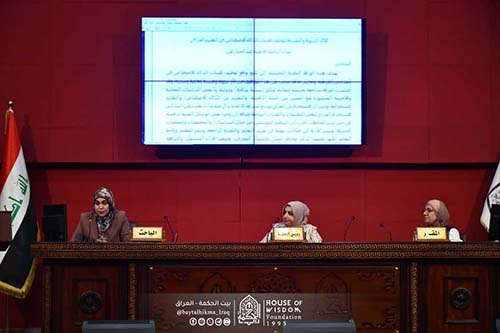
Bayt Al-Hikma – Department of Legal Studies, in cooperation with the Parliamentary Legislation Directorate at the Iraqi Council of Representatives, held a scientific seminar today, Monday, 17 August 2026, entitled “The Federal Council Law: A Constitutional Entitlement and the Imperatives of Legislative Balance,” at Al-Khwarizmi Hall at Bayt Al-Hikma.
The session was moderated by Dr. Ezz Al-Din Al-Muhammadi, Supervisor of the Department of Legal Studies, and rapporteured by Assistant Lecturer Ali Hussein Shihab, Director of the Scientific Coordination and Follow-up Division at Bayt Al-Hikma.
The seminar highlighted the importance of enacting the Iraqi Federal Council Law, its role in strengthening the quality and soundness of legislation in Iraq, and its contribution to addressing the challenges and controversies surrounding legislation issued by the Iraqi Council of Representatives.
The seminar comprised four thematic sessions featuring a distinguished group of professors specialized in law. Dr. Abbas Al-Aqabi, from the College of Law at the University of Baghdad, presented a paper addressing the constitutional basis of the Federal Council and the implications of enacting its law. He reviewed the positive and negative effects that could result from the law’s enactment, as well as the challenges and legal complexities accompanying the legislative process.
Meanwhile, Dr. Thaer Al-Araji, from the Parliamentary Legislation Directorate at the Iraqi Council of Representatives, presented a research paper discussing the requirements for building a federal state and the associated legal and political challenges through an analytical study in light of the Constitution of the Republic of Iraq of 2005. He emphasized the importance of establishing the Federal Council as a necessary step toward completing the institutional structure of the legislative authority.
Dr. Wael Munther Al-Bayati, from the College of Basic Education at Al-Mustansiriyah University, also participated with a paper examining the importance of achieving legislative balance in Iraq as a safeguard against the risks of hasty legislation. He explained that the Federal Council, operating in parallel with the Council of Representatives, could contribute to reviewing and scrutinizing decisions and laws. He also presented several scenarios for structuring the Federal Council in a manner that would achieve legislative balance in Iraq.
For his part, Dr. Hazem Al-Radini, Deputy Chairman of the Strategic Center for Human Rights, delivered a presentation on comparative experiences of federal councils around the world, mechanisms for activating the Iraqi Federal Council, existing challenges, the stages for implementing the proposed framework, and the required procedures. He emphasized the role of the Federal Council in transforming federalism from a framework for political conflict into a stable institutional state.
In a related context, Dr. Amir Al-Kinani, Adviser to the President of the Republic for Legislative Affairs, delivered an intervention outlining the efforts undertaken by the Presidency of the Republic to enact the Iraqi Federal Council Law during the successive parliamentary terms witnessed by Iraq in recent years. He also highlighted the key challenges that have hindered the enactment of the law.
In conclusion, Dr. Qahtan Naama Hassan Al-Khafaji, Adviser to Bayt Al-Hikma, presented certificates of appreciation to the participating professors in recognition of their efforts and contributions to the success of the seminar. The session also featured substantive interventions and insightful comments that contributed to enriching the scientific discussions. |
| Prepare the Printer Back to Detail Page |