.jpeg)
receipt of scientific research
Search
Monthly activity schedule
Statistics
Current Visitors No : 40
Today Visitors No : 2274
Yesterday Visitors No : 3243
Total Visitors No : 2176750
Today Visitors No : 2274
Yesterday Visitors No : 3243
Total Visitors No : 2176750
Complaints and suggestions
From Photo Gallery
E-IRAQ
Newsletter
News Details
Human solidarity in confronting contemporary crises from an Islamic perspective
10-02-2026
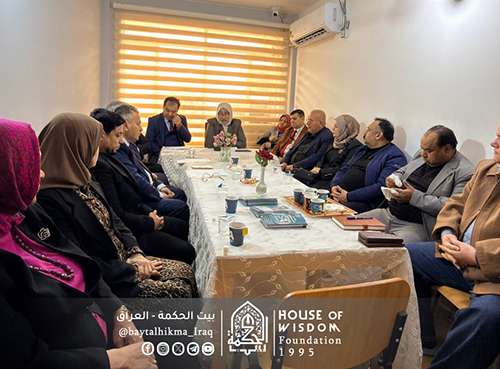
Human Solidarity in Confronting Contemporary Crises from an Islamic Perspective
Bayt al-Hikma – Department of Islamic Studies, in cooperation with the International Center for Training and Development, organized a scientific seminar entitled “Human Solidarity in Confronting Contemporary Crises from an Islamic Perspective” on Monday, 9 February 2026, at the headquarters of the International Center for Training and Development. The event was attended by Dr. Raed Akla Al-Zaidi, Member of the Board of Trustees of Bayt al-Hikma.
The session was chaired by Prof. Dr. Huda Abbas Qanbar, a member of the Advisory Committee of the Department of Islamic Studies at Bayt al-Hikma, while Dr. Dhiaa Fakher Jabr, Assistant Professor and member of the editorial board of the Journal of Religious Studies at Bayt al-Hikma, served as rapporteur.
The seminar highlighted the importance of human solidarity in Islamic thought as a fundamental pillar for achieving social cohesion and cooperation as advocated by Islamic law. It emphasized that this solidarity represents a universal ethical framework grounded in justice, mercy, and respect for human dignity. The discussions also demonstrated how Qur’anic values move beyond theoretical principles to become active social practices and humanitarian discourses that contribute to addressing crises and strengthening societal cohesion.
The seminar featured the participation of a distinguished group of researchers and academics who presented scholarly papers addressing human solidarity from intellectual, Qur’anic, and linguistic perspectives. Prof. Dr. Amer Abdul Amir Hatem (College of Education – Ibn Rushd / University of Baghdad) presented a paper entitled “The Role of the Human Being in the Movement of History from the Perspective of Islamic Thought,” in which he discussed the human role in shaping history as a responsible and divinely entrusted vicegerent on earth.
Prof. Dr. Ridha Kamil Al-Mousawi delivered a paper titled “The Language of Human Solidarity in Contemporary Islamic Discourse: A Pragmatic Approach to Confronting Crises,” shedding light on the language of solidarity as an effective pragmatic structure that produces meaning and reconstructs human bonds amid intertwined crises.
Assistant Professor Dr. Sahira Abbas Qanbar, Director of the International Center for Training and Development, presented her paper “The Human Dimension in Islam and Its Role in Addressing Contemporary Crises,” reviewing Islamic values as realistic solutions to modern crises and outlining mechanisms for their application in achieving security and stability.
Dr. Ali Jawad Hassan, from Al-Talib Iraqi Foundation, presented his paper “Human Solidarity: Qur’anic Values for Confronting Contemporary Crises,” in which he clarified the concept of human solidarity in the Holy Qur’an and its central importance in addressing crises through affirming the unity of human origin, human dignity, and collective responsibility.
Concluding the seminar, Dr. Khazal Ghazi, from the Presidency of the Republic, presented his research entitled “Human Solidarity in Confronting Contemporary Crises: A Qur’anic Vision,” emphasizing that activating the values of dialogue, mutual support, and collective responsibility constitutes the most effective practical framework for addressing contemporary crises and achieving societal stability and peace.
The seminar was attended by a number of researchers, professors, and interested participants whose interventions and valuable suggestions enriched the discussion and contributed to deepening the seminar’s dialogue and strengthening its scholarly outcomes
More News
The vision and mission
Strategy Plan

FREE books
Film
Change the value of the Iraqi currency .. Benefits and costs Seminar held by the Department of Economic Studies
Clock
Visitor Map
mop
Energy subsidies and emissions reduction